AI STRATEGY & MARKET INTELLIGENCE
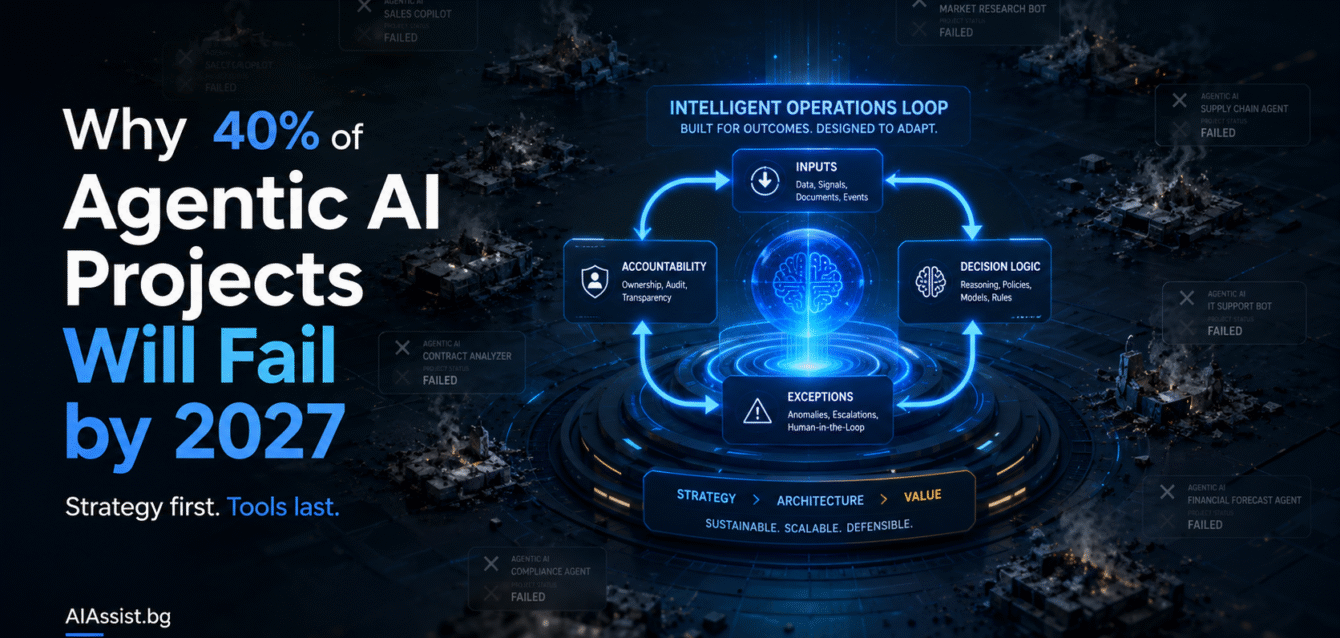
Gartner predicts a mass extinction event in agentic AI. The organizations that survive won’t be the ones with the best models, they’ll be the ones with the clearest operational thinking.
June 2026 • 13 min read • AIAssist.bg
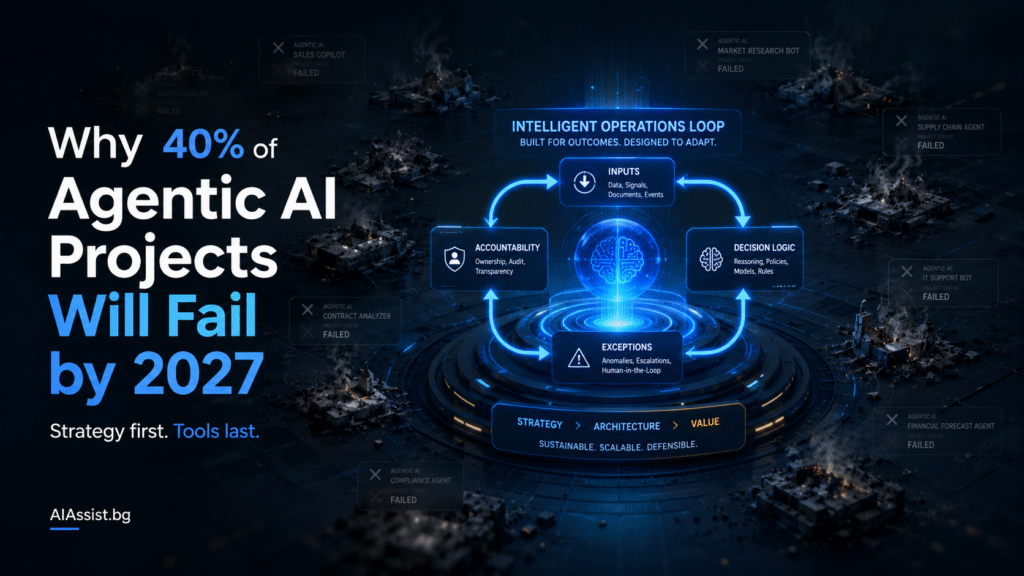
Gartner has issued what amounts to an extinction forecast: by the end of 2027, more than 40% of agentic AI projects will be abandoned. Not because the technology failed. Not because the models weren’t capable. Because the organizations building them never had the operational clarity to make them work. In a market drowning in ten million vendors, unclear cost structures, and absent risk controls, the projects that survive will be the ones that started with the work, and not the tool.
The Most Expensive Mistake in AI Strategy
There is a pattern we see in almost every failed AI initiative, and it starts in the same place: the vendor evaluation.
Leadership decides the company needs AI. A team is assembled. Vendors are invited to pitch. Models are compared on benchmarks and demo performance. A selection is made. Implementation begins.
And then, six to twelve months later, the project is quietly shelved. Not because the technology was wrong, but because nobody ever clearly defined what the technology was supposed to do, at the level of operational specificity that actually matters.
The most expensive mistake in AI strategy is believing that AI investment starts with the vendor or the model. It doesn’t. It starts with the operating loop.
A workflow is not a prompt. It’s not a chatbox. It’s not a vague business objective like “improve customer experience” or “automate finance operations.” A workflow is a discrete system defined by four elements: what data enters the system, what actions the agent is permitted to execute, what constitutes a successful result, and who owns accountability when things go wrong.
When you skip that analysis (and the overwhelming majority of organizations do) you end up with tools that solve nothing, pilots that never graduate to production, and an increasingly skeptical leadership team that starts to view AI as an expensive distraction.
The Golden Rule of AI Deployment
Do not automate what you cannot describe.
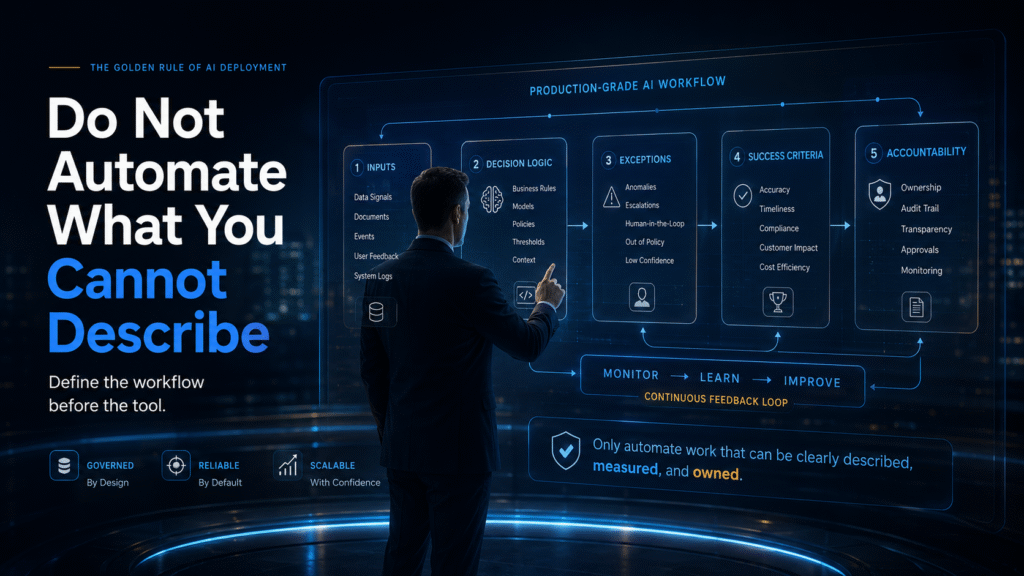
If your team cannot describe a task in plain language mapping the inputs, the success criteria, and critically, the exceptions that task is not ready for AI. Full stop.
This sounds obvious. In practice, it is violated constantly. The typical pattern looks like this: an executive gives a vendor a broad mandate (“automate our accounts receivable process”), the vendor builds to the happy path, the demo looks impressive, and everyone signs off. Then the system hits production, encounters the 30% of cases that are complex exceptions nobody defined, accuracy craters, and the project is abandoned.
Consider accounts receivable as a concrete example. There is no singular “AI for AR.” Instead, there are at least half a dozen distinct shapes of work within that single department: invoice matching, collections prioritization, dispute resolution, payment application, credit assessment, and reconciliation. Each one has different inputs, different success criteria, different exception patterns, and different accountability structures.
Treating them as a single procurement exercise is a recipe for failure. You must invest in the loop, not the label.
Where the Value Actually Lives
Here’s what most implementations get fundamentally wrong about exceptions: in many high-value workflows, the exception is where the value lives.
The straightforward, rule-based cases (the 70% that follow the happy path) are often already handled reasonably well by existing systems. The real operational pain, the real cost, and the real opportunity for AI-driven improvement sits in the complex exceptions that require judgment, context, and nuance.
If your AI implementation is designed around the happy path and treats exceptions as edge cases to be handled later, you’ve built a system that automates the easy part and leaves the expensive part untouched. That’s not transformation… it’s a more sophisticated way of maintaining the status quo.
Stop Searching for the Impossible Hire
There is a hiring pattern in the market right now that is actively damaging AI adoption timelines. Organizations are searching for what can only be described as a mythical candidate… someone who is simultaneously a deep domain expert, an AI architect, an executive communicator, and a change management specialist.
While companies stall their progress searching for this impossible hire, the practical talent they actually need (the people who can do specific, well-defined pieces of the work) is being absorbed by competitors who have a more realistic talent strategy.
A sustainable approach involves hiring for the specific gaps your current team cannot fill:
- Evaluation Design
Specialists who can define what “good” looks like. What are the success criteria? What accuracy threshold is acceptable? How do you measure whether the system is actually delivering value? Without this role, you have no way to know if your AI investment is working. - Workflow Engineering
Technical architects who build the actual operating loop. Not the model selection, not the prompt engineering… the full system of inputs, decision gates, actions, human handoffs, and outputs that constitutes a production-grade AI workflow. - Domain Trust
Experts who ensure the AI respects industry-specific nuances, compliance requirements, and operational realities that a general-purpose vendor will miss. These are the people who know why certain exceptions exist and what happens when they’re handled incorrectly. - Executive Ownership
Leaders who view AI through the lens of capital allocation and risk management rather than technology adoption. Someone who asks “what is the return on this specific workflow investment” rather than “are we doing AI yet.”
Four distinct roles. Four distinct skill sets. The organization that hires for all four will ship production AI systems. The one still searching for a single person who embodies all four will still be writing job descriptions in 2028.
Strategic Inertia: The Undervalued Discipline
In a market driven by hype, “waiting” is often perceived as a weakness, a sign that leadership lacks vision or urgency. This perception is actively harmful.
In strategic practice, inertia is a resource. Change management capacity, the organizational ability to absorb, adopt, and sustain new ways of working, is finite. Think of it as “change capital.” Every transformation initiative you launch spends some of that capital, whether the initiative succeeds or fails.
The disciplined question is not “where can we deploy AI?” but “where will AI-driven change deliver the highest return on our limited change capital?”
This means being ruthlessly honest about what doesn’t need to change. If your deterministic SQL queries are pulling accurate data reliably, replacing them with a non-deterministic AI agent is a low-leverage move that consumes change capital for minimal gain. Preserve that capital for the transformations where AI can do what humans or legacy systems genuinely cannot, like complex analytical synthesis, natural language interpretation of unstructured data, or decision support across large, ambiguous datasets.
Not every process needs AI. And deploying AI into a process that was already working well is one of the fastest ways to burn organizational trust in the entire initiative.
The Build vs. Buy Decision: A Framework That Actually Works
One of the most consequential decisions in AI strategy (and one that most organizations get wrong) is determining what to build internally versus what to buy from the market. The answer isn’t binary, and it isn’t the same for every workflow.
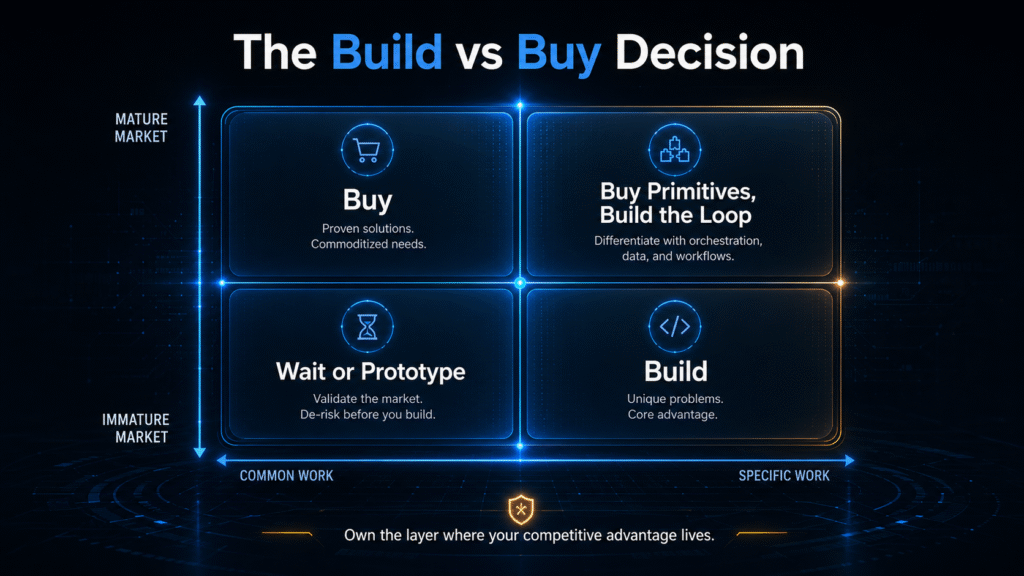
The right framework evaluates each workflow on two dimensions: how specific the work is to your competitive advantage, and how mature the available market solutions are.
Buy: Common Work, Mature Market
When the work is standardized (like a help desk or basic document processing) and proven solutions exist, use off-the-shelf products. Don’t build competitive advantage on commodity work. Commoditize the cost and move on.
Wait or Prototype: Common Work, Immature Market
When the work is standardized but the market solutions are still immature, resist the pressure to sign long-term contracts. The category will be unrecognizable in twelve months. Run lightweight prototypes to learn, but don’t commit capital to a solution that will be obsolete before it’s fully deployed.
Build: Specific Work, Thin Market
When the workflow contains your competitive advantage and no adequate market solution exists, you must own the system. If your differentiation lives in how you handle a specific operational process, outsourcing that to a vendor means outsourcing your moat.
Buy Primitives, Build the Loop
This is the highest-leverage position for most enterprises. Purchase the building blocks, the connectors, the models, the orchestration infrastructure, but build the unique workflow loop that houses the value. You own the standard and the competitive advantage while leveraging commodity technical infrastructure underneath.
The question isn’t “build or buy.” It’s “where in this specific workflow does our competitive advantage live, and who should own that layer?”
The Executive Role Has Fundamentally Changed
The role of the modern executive in AI strategy is not to become the most technical person in the room regarding models or architectures. That expertise can be hired.
The executive’s irreplaceable contribution is operational clarity… the ability to describe, in precise detail, how the organization’s most valuable work actually gets done. What enters the system. What decisions are made. Where exceptions occur. Who is accountable. What “done” looks like.
This is workflow description as a leadership skill. And it is rapidly becoming the single most important capability for any executive responsible for AI investment.
The organizations where leadership can articulate their workflows with precision are the organizations that ship AI systems that work. The organizations where leadership delegates “the AI strategy” to a vendor or a consultant without doing this foundational work are the organizations contributing to Gartner’s 40% failure statistic.
Surviving the Extinction Event
The 40% of agentic AI projects that will fail by 2027 share a common ancestor: vagueness. They began with an abstract desire to “do AI” rather than a specific, operationally grounded understanding of which workflows to transform, why, and how.
The organizations that will survive and thrive are the ones treating AI as a series of discrete operational investments rather than a singular strategic initiative.
This maps directly to the principles we’ve built our entire practice around at AIAssist.bg. Strategy first, tools last. Define the work before choosing the technology. Own the loops that contain your competitive advantage. Preserve change capital for high-leverage transformations.
The path forward begins with a single, unforgiving question:
Can you describe your most valuable workflow in plain language today… the inputs, the decision logic, the exceptions, the success criteria, and the accountability structure? If the answer is no, you’re not ready to invest. And the extinction event is coming.
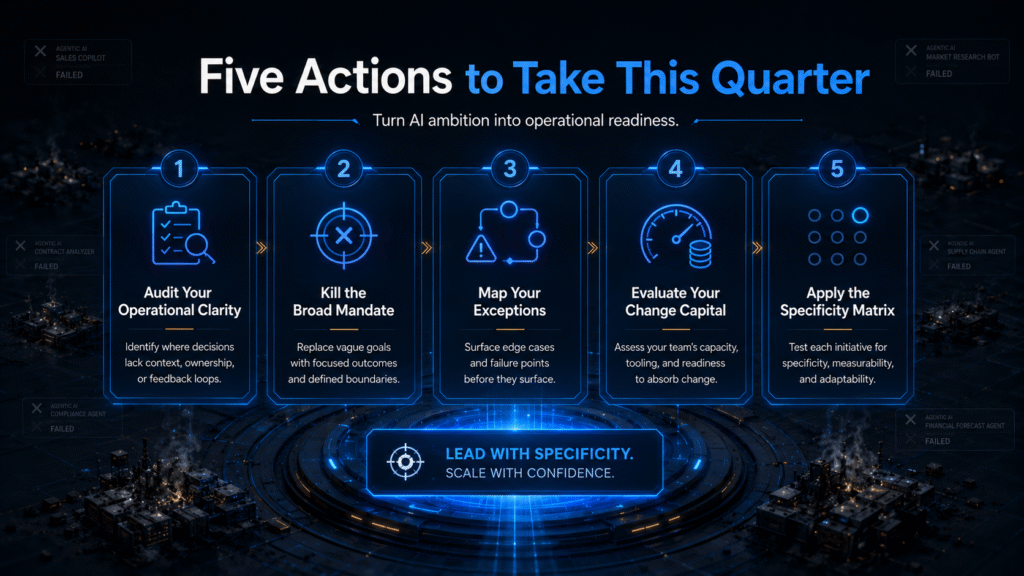
Five Actions to Take This Quarter
- Audit Your Operational Clarity
- Kill the Broad Mandate
- Map Your Exceptions
- Evaluate Your Change Capital
- Apply the Specificity Matrix
Don’t Become Part of the 40%
At AIAssist.bg, we’ve helped 750+ businesses and built 350+ custom AI solutions across three continents. We don’t start with tools… we start with your workflows. Our approach ensures that every AI investment is grounded in operational clarity, not vendor promises.
Book a Free AI Strategy Session →
Take the AI Readiness Assessment →
TAGS: Agentic AI • AI Strategy • AI Failure • Workflow Design • Enterprise AI • Change Management • Build vs Buy
© 2026 AIAssist.bg • aiassist.bg